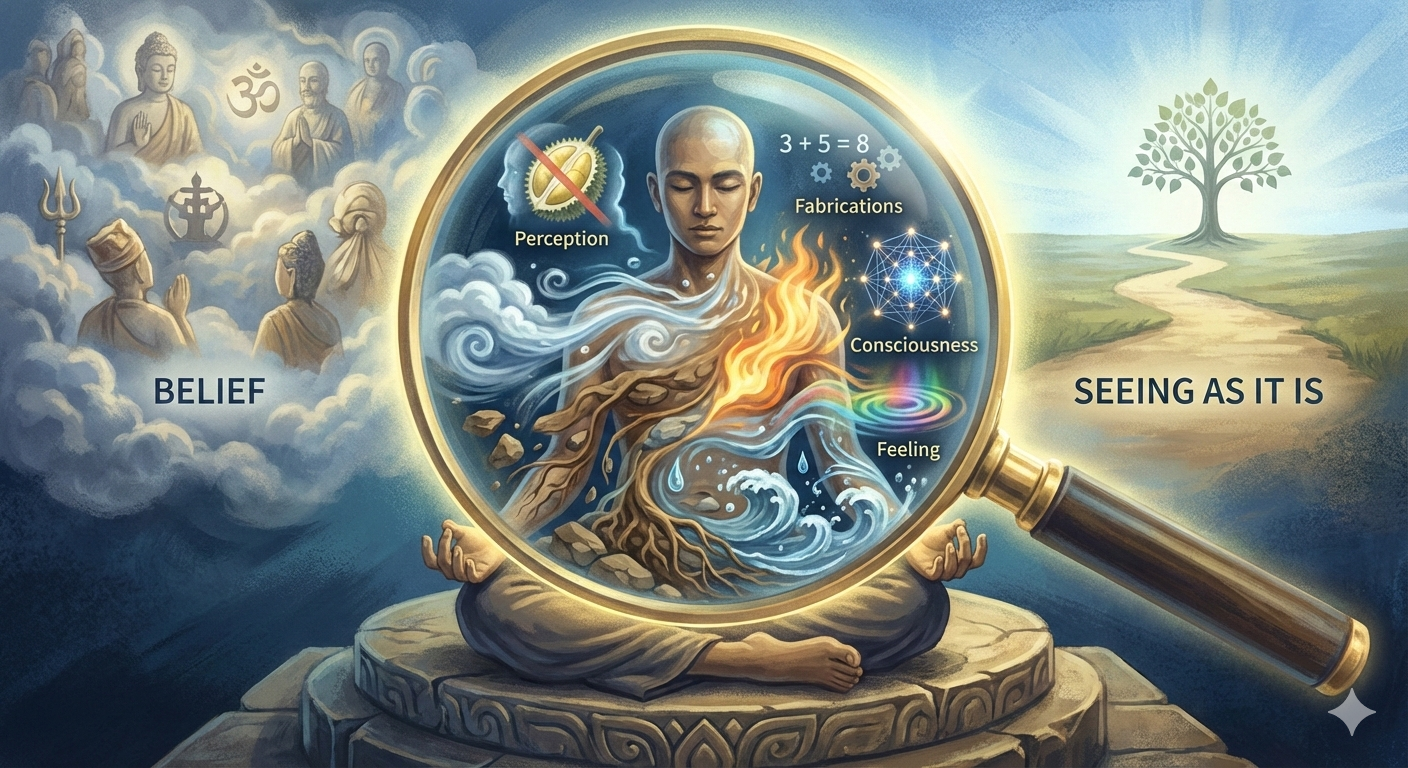
An Article Based on a Dhamma Talk by Ven. Ajahn Kittisobhano (Bhante Huat Poh)
If you were asked to define the essence of Buddhism in a single sentence, what would you say? For many, the answer might involve karma, compassion, or meditation. But do these concepts capture the radical, transformative heart of the path? This article, drawing from the insights of a Dhamma talk by Ven. Ajahn Kittisobhano, explores this fundamental question. We will deconstruct common misconceptions to reveal the Buddha’s core teaching—not as a system of belief to be accepted on faith, but as a practical and verifiable path of wisdom and direct seeing.
1. Differentiating the Path: Beyond Universal Virtues
To engage meaningfully with any path, one must first understand what makes it unique. In a world rich with spiritual traditions and ethical philosophies, clarifying the distinct contribution of the Buddha's teaching is the first step toward effective practice.
Many values commonly associated with Buddhism are, in fact, universal human virtues. As Ven. Ajahn Kittisobhano points out, the injunctions to “avoid evil” and “do good” are cornerstones of nearly every major religion and the personal ethic of countless non-religious people. Visiting an orphanage on one’s birthday or feeling shame at a harmful thought are expressions of a shared human decency, not exclusive markers of a Buddhist practitioner.
Similarly, while meditation is a central pillar of the path, it is not unique to it. Contemplative practices appear across traditions, from Christian prayer to the recitation of God’s names by Muslims using prayer beads. These are all universal forms of training the mind.
If these core practices are shared, what, then, is the critical differentiator? The teaching distills it to a single, profound point: the wisdom of “seeing things as they truly are.” This is the unique territory mapped out by the Buddha. The goal is not merely to accumulate good deeds or calm the mind, but to use a calm, stable mind as an instrument to penetrate the nature of reality itself. Having identified this core wisdom, we must now understand the method for cultivating it.
2. A Science of the Mind: The Principle of Verification
Unlike systems founded on faith, the Buddha’s path is presented as an empirical process of investigation. He did not ask for blind belief. On the contrary, the Buddha’s explicit warning resonates with startling modern relevance: "you don't simply believe anyone." In an age of scams and rampant misinformation, this ancient advice is a crucial survival skill. The path is not about becoming a "blind believer" but an astute investigator of truth.
This principle is illuminated with the analogy of a scientific experiment:
The Hypothesis: A scientist states that a specific type of glass will melt at 385 degrees Celsius under controlled pressure.
The Verification: To prove this theory, the experiment must be replicable. Whether in a lab in Malaysia or one in Japan, if the exact conditions are recreated, the glass will melt. The result is universal and verifiable, independent of location or belief.
This is precisely how the Buddha presented his teachings. The truths he uncovered are not matters of cultural belief or divine revelation; they are universal laws of nature. He taught that anyone, anywhere, who creates the right internal conditions—a mind sharpened by ethics and concentration—can personally verify these truths for themselves. This moves the path from the realm of belief into direct, personal experience. Having established a method of verification, the Buddha turns the microscope away from the external world and points it directly at the most urgent and volatile subject of all: the entity we call "I."
3. The Object of Investigation: Deconstructing the "Self"
Of all the truths in the universe, why focus inward? Because, as the speaker notes, our most immediate and persistent concern is with "me and mine." Suffering doesn't arise from a distant galaxy; it arises from our relationship with this body and mind we call "self." The Buddha's method, therefore, directs our investigation to this most intimate and misunderstood phenomenon.
3.1. The Physical Form: A Temporary Assembly of Elements
Our most basic identification is with this physical body. Yet, a closer look reveals it to be far less solid and stable than we assume. The investigation begins by deconstructing this apparent entity:
The Name as a Label: The name we carry is merely a conventional tag. It can be changed because a palm reader advises it for better luck, or swapped for an English name to seem more modern. It is a label, not the thing itself.
The Body as a Collection: We constantly absorb the outside world and claim it as "me." A glass of water, which was "outside" moments ago, is consumed and instantly becomes part of "my" body. If you were to visit a dentist and have a tooth plucked out, would you speak to it—"homing homing homing"—as if it were still you? Of course not. Once separated, it is no longer identified as "me."
The Body in Constant Flux: This process is relentless. A baby born at 3.5 kilos gathers mass from external sources to become a full-grown adult. Science now confirms that this body, composed of trillions of cells, completely replaces itself roughly every 6.5 years. The "you" of today is a physically different collection of material from the "you" of seven years ago.
The Buddha analyzed this physical form as a temporary composition of Four Great Elements:
Earth: The element of hardness and solidity.
Water: The element of cohesion and liquidity.
Fire: The element of heat and energy.
Wind: The element of movement and pressure.
These elements are interdependent; if one is removed, the others cannot hold together. At death, this dissolution becomes clear. The Wind element (breath) and Fire element (body heat) leave together like “close brothers.” Soon after, the Water element is expelled. Finally, the Earth element—flesh and bone—decomposes, returning to dust. What we call a "body" is not a static entity but a dynamic, conditioned process—a temporary balancing act of these four elements.
3.2. The Mind: A Flow of Conditioned Processes
The Buddha's full analysis of the "self" consists of five aggregates, or khandhas: Body (Rupa), Feeling (Vedana), Perception (Sanna), Fabrications (Sankhara), and Consciousness (Vinnana). Having examined the body, we now turn to the four mental components, whose impersonal nature can be revealed through simple, direct demonstrations.
Feeling (Vedana): Consider a simple experiment. Slap the back of one hand with the other. A feeling of pain arises. Was this pain hiding in the hand before the slap? No. It arose purely because a condition was met. As moments pass, the pain fades on its own. Now, try to command it: "Come back! Come back!" It does not obey. The lesson is clear: feelings arise when conditions are present and cease when conditions cease. They are not "ours" to control.
Perception (Sanna): Now, follow an instruction: "Please don't think about durian. No red durian, no yellow durian, not even a bucket of durian." Inevitably, the mind is flooded with images of the forbidden fruit. Why? The memory appears not because "we" chose to summon it, but because a condition—the mention of the word—was created. Perception is not a personal possession but a conditioned response.
Fabrications (Sankhara): Now, a simple question: "What is 3 + 5?" The answer "8" appears in the mind. Was the number "8" waiting inside you? No. It was fabricated the moment the mind was presented with the conditions: the numbers 3 and 5. This process of sankhara is constantly at work, creating not just simple answers but also our opinions, biases, and the complex mental stories we defend as "mine."
These exercises reveal a profound truth: the constant flow of feelings, memories, and thoughts we identify as "my mind" are actually impersonal phenomena. They arise and pass away according to natural laws, independent of any central owner. This is the crux of the investigation: if these feelings, thoughts, and perceptions are not "us," and not under "our" control, then why do we suffer when they are unpleasant? The answer lies not in the phenomena themselves, but in the mistaken act of claiming ownership.
4. The Root of Suffering: The Misidentification with "Me"
This deconstruction of the self is not an abstract philosophical game; it is the direct diagnosis for the root cause of our suffering. We suffer because we mistakenly claim ownership of these fleeting, impersonal, and uncontrollable processes. We graft the labels "me" and "mine" onto them.
We say "my body," and then suffer when it ages or gets sick. We say "my feelings," and then struggle to get rid of unpleasant ones and cling to pleasant ones. We say "my ideas," and when someone criticizes an idea that simply arose due to conditions, we feel personally attacked.
This constant, mistaken identification is the source of our anguish. The speaker asks, with startling directness, "aren't we like a somebody in the psychiatric ward? no problem just make something up become a problem." An unpleasant feeling arises, and we create a second layer of suffering by resisting it. A critical thought is voiced, and we build a third layer of resentment around it. We are living in a self-constructed drama, suffering for no reason other than our fundamental misunderstanding of who—or what—we are. This internal confusion often leads us to seek external solutions that, ultimately, cannot solve the core problem.
5. The Limits of Merit: A Cautionary Tale
In many Buddhist cultures, the practice of making offerings and doing good deeds—dana, or merit-making—is widespread. While beneficial, a misunderstanding of its function can lead to a dangerous spiritual complacency: the belief that merit is a cosmic insurance policy against all misfortune. To illustrate this, Ven. Ajahn Kittisobhano recounts the cautionary tale of Queen Malika:
Unparalleled Generosity: Queen Malika was a great benefactor who organized an offering to the Buddha and 500 of his enlightened disciples so lavish that no one in the kingdom of Kosala could match it. Her merit was legendary.
A Shocking Outcome: Despite this immense store of positive karma, when Queen Malika died, she fell into a hell realm for seven days.
The Decisive Cause: Her merit could not "protect" her because at the moment of death, her mind was not dwelling on her generosity. Instead, it was overcome by guilt from a past transgression—a time she had betrayed her husband, the king. This final, unwholesome mental state determined her destination.
Queen Malika's immense merit could not save her because at the final moment, she was utterly hijacked by a conditioned mental process—a powerful fabrication of guilt—which she identified with completely. Her story is the ultimate proof that we are at the mercy of whichever conditioned state we claim as "me" when it matters most. For anyone who might dismiss her fate as a "small deal," the speaker offers a visceral challenge: "Come. Bring a pot of boiling water... Put your smallest finger inside for seven minutes... Try, and prove to everybody that this is a 'small deal'." Her story is an urgent call to shift our focus from a reliance on external acts to the crucial, moment-to-moment work of inner transformation.
6. Conclusion: The Urgent Choice—Seeing vs. Believing
The path taught by the Buddha is an active, moment-to-moment investigation of reality, not a passive acceptance of beliefs. It is about trading the comfort of certainty for the liberating power of clarity.
The urgency of this inner work is conveyed through one of the Buddha's most striking analogies. He stated that the number of human beings who, after death, are reborn in a happy destination is comparable to the number of "two horns on a cow." The number reborn in lower, painful realms is comparable to the number of "hairs on that cow's body." This is not a threat, but a stark, statistical observation of the consequences of living in ignorance.
We are therefore left with a profound choice. We can continue living in an imaginary world of "me and mine," creating suffering by misidentifying with impersonal phenomena. Or, we can accept the Buddha's invitation to "bring the truth inside." As the speaker pleads, "Please live in the real world... not in the imaginary world." This means turning our attention inward to discover the profound peace that comes from living in alignment with what is real. The path begins when we make the pivotal shift from merely believing in what the Buddha said to actively seeing for ourselves that what he said is true.