Introduction: Beyond the Clichés
When we think of Buddhist practice, certain images often come to mind: the serene meditator trying to empty their mind, or the stoic practitioner denying all worldly pleasures. The path can seem like one of negation—of ending suffering, of not being reborn, of letting go. While these concepts hold truth, they don’t always capture the vibrancy, creativity, and profound positivity at the heart of the practice.
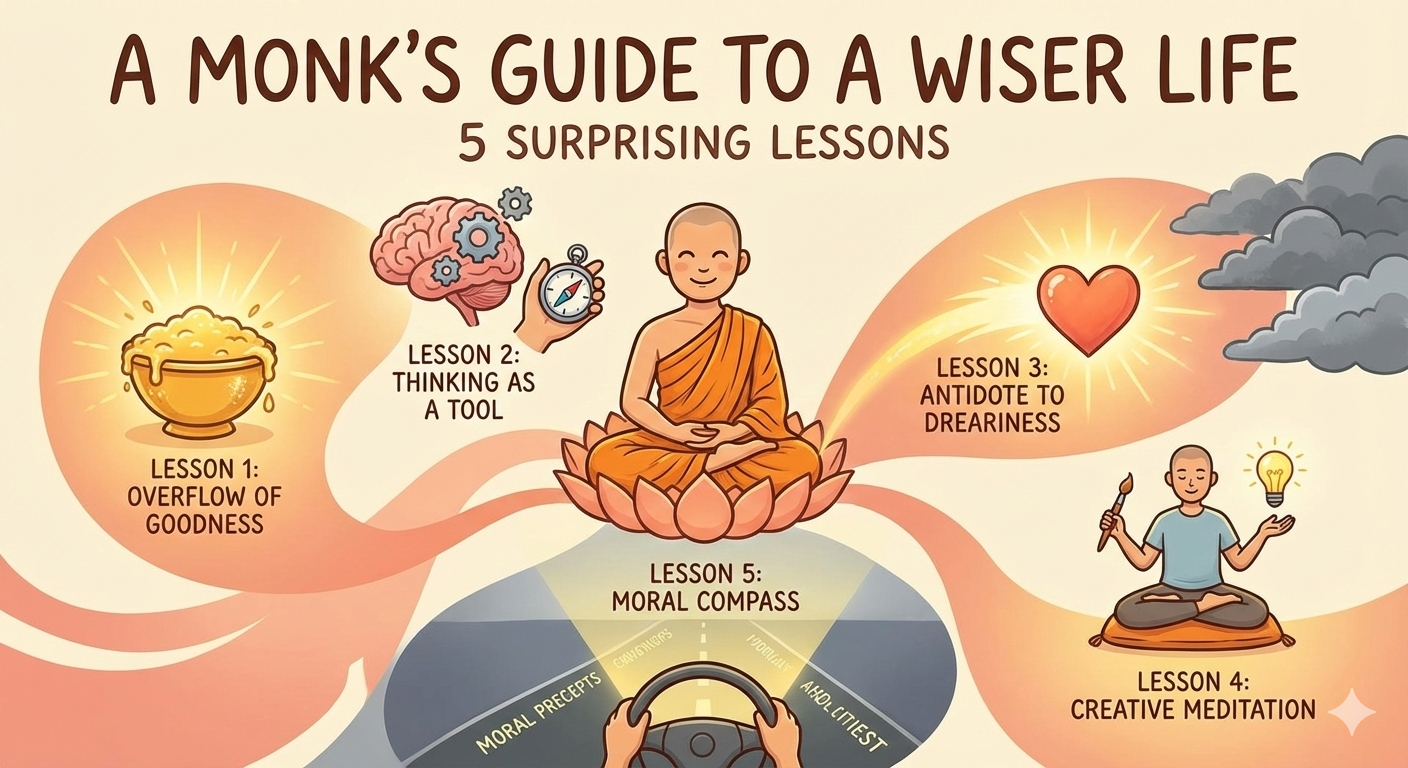
Some of the most transformative teachings are actually quite counter-intuitive. They challenge our assumptions not only about Buddhism but about our own minds and lives. This article explores five impactful takeaways from a Dhamma talk by the insightful teacher Ven. Ajahn Jayasaro. These lessons reframe our approach to mindfulness, joy, and thinking itself, revealing a path that is less about emptying out and more about filling up with wisdom and compassion.
1. The Goal Isn't Emptiness, It's an Overflow of Goodness
Theravada Buddhism, the speaker notes, can sometimes have a "miserable reputation." When its ultimate goal is described in negative terms—like "the end of suffering" or "not being reborn anymore"—it doesn't always inspire the heart. But there’s a reason for this precision. Vague aspirations like "love all sentient beings" can be easy for the mind to get around, whereas a precise training like "You do not intentionally take the life of any being" becomes a practical, powerful object of mindfulness.
While this precision is a tool, a more uplifting way to frame the goal is to see it as practicing for Bodhi, or enlightenment. But what does that mean in real terms? Instead of an abstract, unknowable state, we can look at how Bodhi manifests as observable, positive qualities in an enlightened mind. The speaker identifies three distinct features: Wisdom, Compassion, and Purity. He quickly clarifies the third, noting that "purity" can be a "problematic word" leading to rigidity, which is why he prefers to frame it as a profound Inner Freedom.
...we're practicing for unlimited compassion and wisdom and inner purity and and freedom. For me, that's really much more inspiring, isn't it?
This shift in perspective turns spiritual practice from an act of negation into a positive pursuit. The goal becomes a radiant overflow of goodness, something we can see, feel, and aspire to in a tangible way.
2. Thinking Isn't Your Enemy—It's a Tool You Need to Reclaim
One of the biggest misconceptions in mindfulness is that thinking is the enemy. We strive for a silent mind, treating every thought as an intruder. But Ajahn Jayasaro offers a radical alternative: "Thinking is not your enemy." The opposite of thinking isn't dullness; it is "clarity of mind without thinking."
He uses a brilliant analogy: thinking is like a "servant that's taken over the house and thinks it's the master." The goal isn't to destroy the servant—after all, our ability to think gives us art, science, and solutions to complex problems. The goal is to re-establish discipline and to know the right "time and place" for it. The practice is about learning when to think and when to dwell in clarity without thought.
This also clarifies the popular instruction to "be in the present moment." It does not mean a total absence of past and future. In our direct experience, the past exists as memory and the future exists as thinking. We cannot live without them. The problem arises when we forget that "memory is memory and thinking is thinking" and get lost in them. The true skill is to use these powerful tools when needed, and not let them drag our minds around unconsciously.
3. The Real Opponent of Joy Isn't Jealousy, It's Dreariness
In Buddhist teachings, there are four sublime states of heart known as the Brahma Viharas: loving-kindness (Mettā), compassion (Karunā), sympathetic joy (Muditā), and equanimity (Upekkhā). These aren't just a list of virtues; they form an integrated system. The speaker explains that Upekkhā, or equanimity, is the "wisdom element" that balances the others. It prevents us from burning out when our compassion for someone in pain can't change their situation, reminding us that our good intentions are just one condition among many.
When considering sympathetic joy—the practice of feeling happy for others' success—most of us assume its direct opponent is jealousy. While the practice certainly helps with jealousy, the speaker reveals a more subtle and profound insight. The true opponent of Muditā is the "depressed mood," the "sense of meh," that feeling where everything seems "gray and meaningless and dreary." Sympathetic joy is the direct antidote to this spiritual listlessness.
The practice of Muditā is about actively "recognizing and appreciating goodness," no matter how small. It’s tuning your mind into the countless acts of decency that happen every day—someone holding a door or offering a kind word. The speaker humorously frames this as a "lazy way to enlightenment" because you "don't have to do anything... just watch other people doing it and you just feel wonderful." It’s a simple, accessible way to fill your mind with light and push back against the grayness.
4. You Have Permission to Be Creative With Your Meditation
Many people who meditate live with a persistent fear that they are "doing it wrong," believing there is only one correct technique. This fear is dismantled by a core Buddhist principle called Upaya, or skillful means. The guiding rule is "practicing dharma in accordance with dharma," which means any technique is valid as long as it is in harmony with the major principles of the path, like cultivating wholesome states and letting go of unwholesome ones.
To prove the point, Ajahn Jayasaro shares a technique he invented. Having observed that streams of thought are often linked to tiny, imperceptible movements in the tongue (a process called subvocalization), he developed a new meditation object: "keeping the tongue still." By focusing on preventing the physical movement, he found he could quiet the associated mental chatter. He states plainly, "That's not in any book anywhere. I can guarantee I made it up." This is a powerful permission slip for all practitioners: trust your own observation, be creative, and find what works for you.
5. True Mindfulness Isn't Just for the Cushion—It's Your Moral Compass
In the modern wellness world, mindfulness is often defined simply as "being aware of the present moment." But in its original context, mindfulness (Sati) is much deeper. It must be guided by Sampajañña, or clear comprehension—an understanding of what is wholesome and what is unwholesome. The speaker offers a brilliant analogy: when driving at night, Sati is your hands on the steering wheel, but Sampajañña is the headlights showing you the road ahead.
He explains that the five precepts—refraining from killing, stealing, sexual misconduct, lying, and intoxication—are the "five basic objects of mindfulness in daily life." For example, during a difficult conversation, you can take "no lies" as your mindfulness object. As you develop this, you can make the practice more sophisticated, aiming to speak "only truths which are beneficial, at the right time and place, with a kind heart, and using polite speech."
This is illustrated with a powerful example: if you are meditating and a memory of treating someone poorly arises, causing remorse, the path isn't just to label the feeling and watch it pass away. The real practice is to cut it off at the root—to get off the cushion, go to that person, and sort things out. Meditation isn't a magical tool to bypass life's difficulties; it's one part of the integrated Eightfold Path that informs how we live with integrity and wisdom.
Conclusion: A Practice for Living
These five insights share a common thread: they reveal Buddhist practice as a dynamic, creative, and deeply positive path that is woven into the fabric of daily life, not separate from it. It's not about escaping the world, but about engaging with it more wisely and compassionately. It’s about reclaiming our minds, cultivating joy, and finding freedom through skillful, heartfelt effort.
With these insights in mind, what is one small, "made-up" practice you could experiment with this week to cultivate more wisdom, compassion, or inner freedom in your own life?