
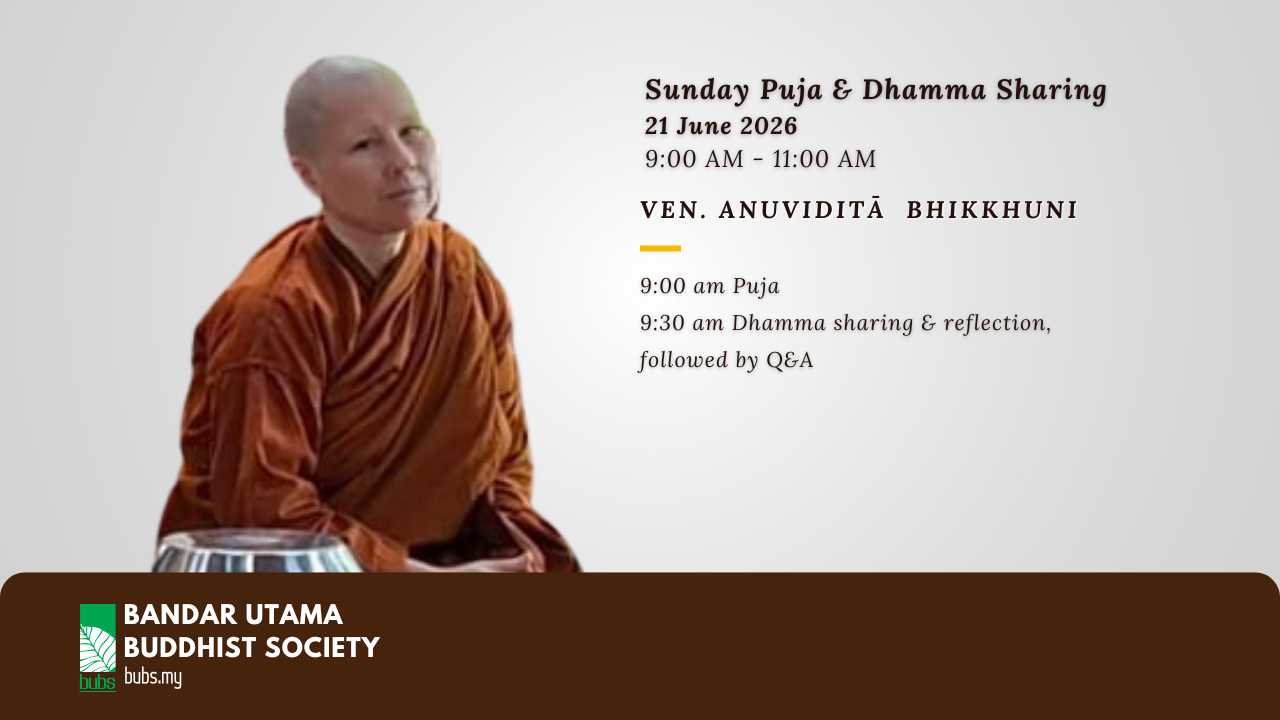
First of all, I want to express my deepest gratitude to the Bandar Utama Buddhist Society (BUBS) for the kind invitation to share a brief Dhamma reflection with you.
Being here, I can feel that the Dhamma energy of the people practicing in this place is so tangible. I feel very grateful to be here with all of you.
Namo Tassa Bhagavato Arahato Sammā Sambuddhassa (3x)
Buddhaṁ Dhammaṁ Saṅghaṁ Saranaṁ Gacchāmi
Seeking Wise Counsel: What to Share?
When I was invited to give a Dhamma reflection here in Kuala Lumpur, I consulted with two of my venerable monastic friends and asked them, "What can I share with the people in Kuala Lumpur? What might be useful for them?"
They both gave me very wise advice. One of them recommended that I talk about Sammā-diṭṭhi—Right View—and its crucial importance for our daily lives and our spiritual practice. The other suggested that I reflect on the Velāma Sutta, which beautifully highlights the ultimate fruits of our practice.
Let us explore these two beautiful areas of the Dhamma together.
Understanding Right View (Sammā-diṭṭhi)
As many of you may know, the Buddha spoke of two kinds of Right View: mundane (lokiya) Right View and supramundane (lokuttara) Right View.
1. Mundane Right View: The Ground of Daily Life
Mundane Right View is the foundation of our daily conduct. It begins with the acknowledgment of Kamma—understanding that we are the owners of our deeds, responsible for our actions, and that our choices have consequences.
Part of this mundane Right View is the development of generosity (dāna). It is clear that all of you at BUBS are already practicing this deeply. Just by being here, volunteering, and practicing together, you are expressing a beautiful sign of generosity.
Another vital aspect of mundane Right View is the acknowledgment and gratitude we owe to our mother and father. I recently watched your society's 25th-anniversary video, and I was so touched to see how you educate the children here to pay respect to their parents. Learning this gratitude for the beautiful gift of life, and recognizing all the energy our parents put into raising us, is a highly precious practice.
2. Supramundane Right View: The Four Noble Truths
Supramundane Right View goes deeper; it is the direct understanding of the Four Noble Truths.
Sometimes people think of the Dhamma as highly theoretical or far removed from daily life, but it is actually incredibly practical. The Dhamma is not for someone else—it is for us. Its purpose is to help us transform our lives for the better, so that we can live more skillfully, more wholesomely, and reduce our dukkha (suffering).
To do this, we must truly understand dukkha. We all know the classical definition of the First Noble Truth: birth is dukkha, aging is dukkha, sickness is dukkha, and death is dukkha. But there is a crucial line that we sometimes skip over: "In short, clinging to the five aggregates (pañcupādānakkhandhā) is dukkha."
These five aggregates—form (rūpa), feeling (vedanā), perception (saññā), mental formations (saṅkhāra), and consciousness (viññāṇa)—are not abstract concepts. They are the building blocks of our daily, moment-to-moment reality.
Consider the aggregate of feeling (vedanā). Working with feelings can be highly challenging. But when we understand what a feeling actually is—when we see it simply as a passing phenomenon rather than personalizing it—it loses its power over us. We can then manage difficult emotions and situations much more skillfully.
The Velāma Sutta: A Ladder of Merit
This brings us to the advice of my second monastic friend, who recommended the Velāma Sutta (Anguttara Nikāya 9.20). I am a big fan of the Suttas; they are incredibly precious gifts left to us, and they offer deeply practical guidance if we investigate them.
The Velāma Sutta records a conversation between the Buddha and Anāthapiṇḍika, the great lay benefactor. The Buddha shares a story from one of his past lives when he was a Brahmin named Velāma. As Velāma, he made an unimaginably massive donation. He gave away eighty-four thousand gold cups, silver cups, noble carriages, and countless other treasures.
Yet, the Buddha points out a profound truth: because there were no noble disciples (Ariya-saṅgha) present to receive these gifts at that time, the spiritual merit of that colossal material donation was limited.
The Buddha then lays out a beautiful spiritual hierarchy of merit:
Feeding one person with Right View (a Stream-enterer, or Sotāpanna) is far more beneficial than making that massive material donation to those without Right View.
Feeding one Once-returner (Sakadāgāmī) is more beneficial than feeding a hundred Stream-enterers.
Feeding one Non-returner (Anāgāmī) is more beneficial than feeding a hundred Once-returners.
Feeding one Arahant is more beneficial than feeding a hundred Non-returners.
Feeding one Paccekabuddha (Silent Buddha) is more beneficial than feeding a hundred Arahants.
Feeding a fully enlightened Buddha is more beneficial than feeding a hundred Paccekabuddhas.
Offering a gift to the Sangha (the monastic community) is more beneficial than offering it to the Buddha alone.
Building a dwelling (monastery) for the Sangha is even more beneficial than offering them food. Building a shelter supports those who are actively practicing and preserving the path.
Taking refuge in the Triple Gem (the Buddha, Dhamma, and Sangha) with a confident heart is even more beneficial than building a monastery.
Undertaking the Five Precepts (Pañcasīla) with a clear mind is even more beneficial than taking refuge.
Developing a heart of loving-kindness (Mettā), even for the duration of a finger-snap, is more beneficial than keeping the precepts.
Developing the perception of impermanence (Anicca-saññā) is the most beneficial and meritorious practice of all.
Bringing the Teachings Into Our Hearts
If we look closely at this ladder of merit, we find beautiful, practical lessons for our daily lives.
The Joy of Morality (Pañcasīla)
Keeping the Five Precepts is a core part of Right View. We shouldn’t keep them merely as a passive label because we call ourselves Buddhists. If we do that, we lose the real, deep benefit: the calmness of heart, the joy, and the happiness that arise from knowing we are doing our best to live harmlessly.
Years ago, one of my first Dhamma teachers, Ajahn Dhammapalo, said something that completely stuck with me:
"No matter what you do, even if no one is looking, even if no one sees how you are acting—one person is always watching, and that is yourself."
Remembering this is incredibly helpful whenever we are tempted to be lazy or lax in our precepts!
We must be upright and honest in our conduct, but we also need a quality of gentleness and kindness toward ourselves. We live in a highly success-oriented society where we constantly feel the pressure to prove our worth. A humble, gentle, and forgiving attitude toward our own struggles is essential nourishment on the path.
The Intention of Loving-Kindness (Mettā)
Mettā is not merely a warm feeling; it is a conscious intention. It is the decision: "May all beings be well."
When we train ourselves in this intention, it expands our heart. It is like putting on "Dhamma glasses"—similar to putting on sunglasses on a bright day! Through these lenses, we see everyone around us with kindness. We recognize that every single being is suffering in some way, and that whatever unskillful things they do, they do them simply because they mistakenly believe it will lead to their happiness. This perspective changes how we respond to challenging situations and helps us cultivate patience and endurance.
The Pinnacle of Practice: The Perception of Impermanence (Anicca-saññā)
Why is Anicca-saññā placed at the very top of the Buddha’s ladder of merit? Because the perception of impermanence is the ultimate tool to cut through greed, hatred, and ignorance (avijjā).
If we look at our lives, we spend an enormous amount of energy trying to maintain things, trying to keep things from falling apart. It is deeply exhausting. When we look at our daily experience through the lens of impermanence, we find immense relief.
When you find yourself in a highly stressful situation, you can pause and ask:
“Why am I struggling so hard right now? What is the point of this? In fifty years, where will this situation be? Where will this feeling be?”
We feel miserable or stressed, but if we observe closely, we see that these feelings arise, change, and pass away on their own. The less we interfere with the natural flow of these phenomena, the calmer the mind becomes.
Conclusion
We are incredibly fortunate to have the teachings of the Buddha still available to us today, more than 2,500 years later. It is a teaching that is completely practical, testable, and deeply transformative. The Buddha did not ask us to simply believe what he said; he invited us to investigate, to practice, and to see the truth for ourselves.
By training ourselves in generosity, keeping our precepts with joy, wearing our "Dhamma glasses" of Mettā, and remembering the liberating truth of Anicca, we gradually bring our minds to peace.
Let us sit together for a guided meditation. after which we open the floor for any questions.
Disclaimer
Please Note: This transcript or translation have been prepared by volunteers as a service to the community, aiming to make the Dhamma teachings accessible to devotees.
While every effort has been made to accurately capture the essence, warmth, and profound meaning of the original discourse, translations across languages and cultural contexts are inherently imperfect. This text should be used as a guide for contemplation rather than a definitive, literal transcript. Any errors, omissions, or misinterpretations are entirely the responsibility of the translator and do not reflect upon the purity of the Dhamma or the teacher.