
Dharma Sharing by Bro Lim Kooi Fong, BUBS, 5 July 2026
Cancer is one of the most challenging experiences a person can face. It brings fear, uncertainty, and often a sense of helplessness. Bro Lim Kooi Fong, in his Dharma sharing at BUBS on 5 July 2026, offers a practical and compassionate way to navigate this difficult journey using Buddhist teachings. His approach is not about denying the reality of cancer or pretending it is easy. Instead, it is about facing the situation with wisdom, acceptance, and kindness towards oneself.
Part 1: Facing Facts
The first step in dealing with any difficulty is to face the facts. Bro Lim explains that cancer is not a simple disease. Modern science has shown that tumors are complex and ever-changing. He introduces three key concepts: intratumoural heterogeneity, clonal evolution, and the TRACERx study.
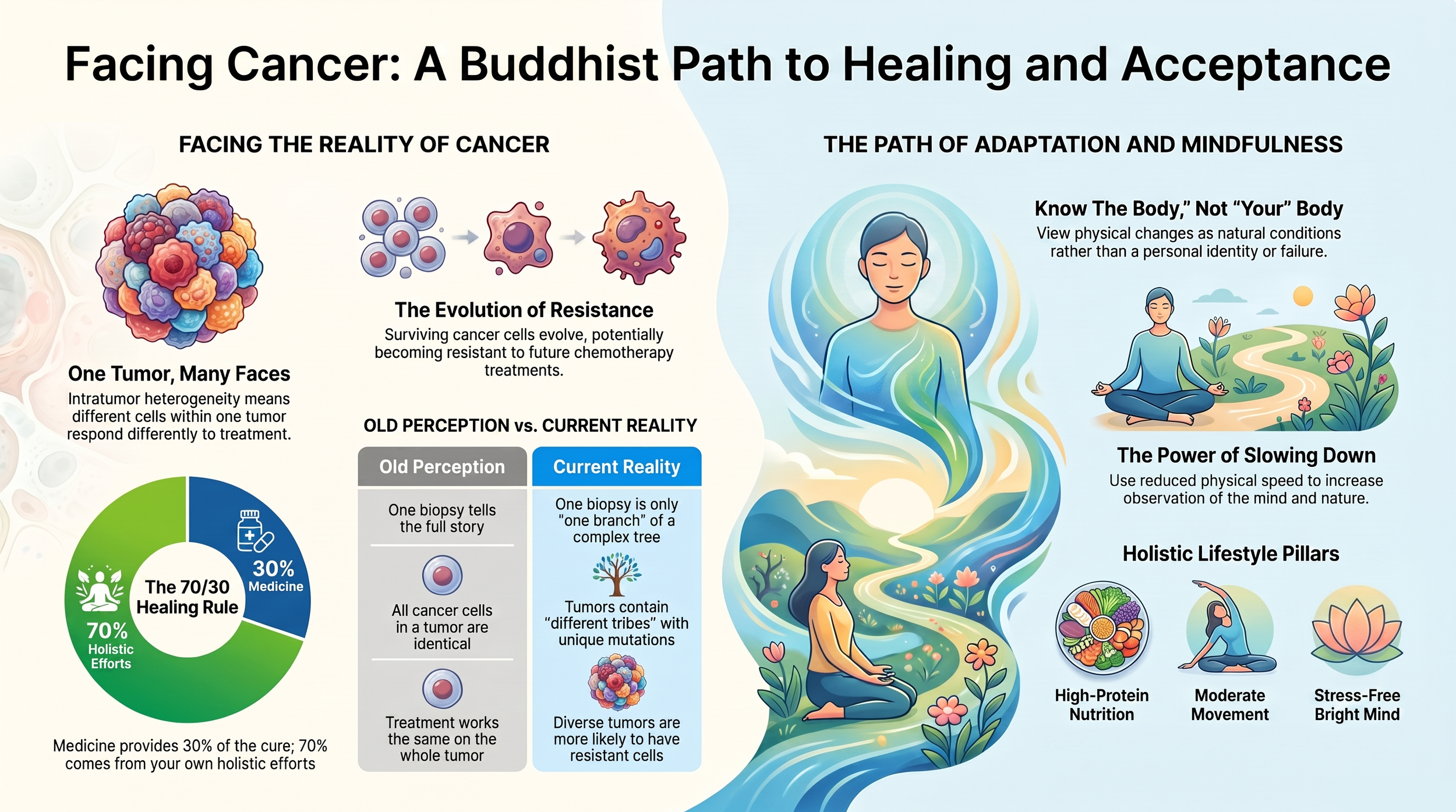
Intratumoural heterogeneity means that a tumor is made up of many different types of cancer cells. This is important because it tells us that one small piece of a tumor does not represent the whole thing. Different areas of the same tumor behave differently. Some cells are easy to kill with treatment, while others are not. This is why treatments often fail in the long run. They target only one type of cell, and the survivors grow back.
Clonal evolution takes this further. Inside a tumor, there are many "clans" or clones of cancer cells, all competing to survive. When chemotherapy comes, it kills the weak ones. But the tough ones survive, multiply, and take over. If chemotherapy kills 99.9% of cells, the remaining 0.1% that survives may become even stronger and resistant to future treatment.
The TRACERx study by Dr. Charles Swanton confirms this reality. Doctors used to think one biopsy told them everything about a tumor. But the study shows that one biopsy is like looking at one branch of a huge tree. You miss all the other branches. Different parts of the same tumor have different mutations. Some branches are easy to kill, while others are naturally resistant. The more diverse the tumor, the more likely some cancer cells will survive treatment and grow back.
For a Buddhist practitioner, this understanding helps us see the truth of impermanence and the nature of suffering. The facts tells us that cancer is not a simple enemy to defeat. It is a dynamic and complex process.
By facing these facts, we stop living in denial and waste time by chasing unproven solutions. Facing reality allows us to start preparing ourselves for what lies ahead. There is no time to waste. We need to take decisive actions.
Part 2: Accepting Current Condition
Once we have faced the facts, the next step is acceptance. Bro Lim emphasizes that acceptance is not about giving up. It is about acknowledging the reality of the situation and reorienting our minds.
First, we must accept the time limit to life. Cancer reminds us that we are not immortal. Instead of asking "why me?" or "what if?", we get the facts and face reality. This is not pessimism. It is wisdom. The Buddha taught that all conditioned things are impermanent. Our bodies are conditioned things. They will age, get sick, and eventually die. Cancer is just one manifestation of this universal truth.
Second, we must "know the body." Bro Lim makes an important distinction between "know your body" and "know the body." The body we have now is not the body we had before treatment. It has changed. It may be weaker, more tired, or different in many ways. We need to observe these changes without judgment and without clinging to how things used to be.
Third, we must reorient ourselves to understand our current condition. Instead of asking "why is this happening?", we ask "if this, what then? If that, then how?" This practical approach helps us take action. It moves us from helplessness to empowerment. We stop fighting against reality and start working with it.
Part 3: Adaptation and Conditioning
The third part of the sharing is about adaptation and conditioning. Bro Lim shares his personal experience and practical strategies for living with cancer and its treatment.
Slowing Down
After surgery and during treatment, the body needs time to recover. Bro Lim advises slowing down in every aspect of life. This means eating slowly, walking slowly, managing fatigue, and being careful about contamination. He also emphasizes body watching ( _kaya nupassana_ ) and mind watching ( _citta nupassana_ ). This is the practice of mindfulness. We use our _samatha_ experience to observe our body and mind without attachment or aversion, and through objective observation, we learn to accept our current state and respond wisely.
Managing Chemotherapy Effects
Bro Lim shares his experience with two rounds of chemotherapy. The first round was CAPOX, stopped after six treatments. The second round was Forfiri with Cetuximab, lasting twelve treatments. He experienced side effects like mouth ulcers, pimples, metallic taste, watery eyes, and neuropathy. These are difficult experiences. But by acknowledging them and adapting to them, he was able to continue his journey with dignity.
Holistic Treatment
Bro Lim emphasizes that treatment is not just about medicine. It is holistic. It includes diet, exercise, rest, and maintaining a light and bright mind.
For diet and nutrition, he reflects on the purpose of eating. He shared the Vinaya's "reflection on food", which implotres us to eat not for fun or pleasure, but for the maintenance and nourishment of the body. He advises smaller meals more frequently, liquid meals when solid food is rejected, and a balanced diet with protein, fibre, and plenty of water.
For exercise, he suggests starting with simple tasks like washing dishes, cleaning the house, walking, and cooking. The aim is to ensure that the organs inside the body are kept functioning normally. The key is not to over-exert. Do what you can, and be kind to yourself.
For rest and sleep, he advises ensuring seven to nine hours of sleep per day, including afternoon naps. Rest when the body feels tired or out of breath.
For maintaining a light and bright mind, he suggests minimizing stress, stopping over-thinking, and appreciating small simple things like blue skies, birds singing, and serene Buddha faces. He also mentions using a singing bowl to calm the mind and doing Dharma work in the digital realm.
30% Medicine, 70% Personal Effort
Bro Lim concludes that treatment is about 30% medicine and 70% personal effort. This 70% includes diet, exercise, rest, and a stress-free mind. This is not to say that medicine is unimportant. It is to say that our own efforts play a crucial role in our healing journey.
Realization
Bro Lim shares four key realizations from his journey.
First, acceptance. Cancer has come. This is the truth of dukkha. We cannot escape the arising suffering, but we can face it with courage.
Second, kindness towards oneself. Relax. There is a way out of suffering, as taught in the Third Noble Truth. If there is no way out, then what is the problem? He reflects on the _four brahma viharas_ : loving-kindness, compassion, sympathetic joy, and equanimity. He even treats cancer cells as beings worthy of loving-kindness. Do not harbour hate or anger. They arise due to right conditions.
Third, understanding cause and effect. With mindfulness and slowing down, and using _samadhi_ as base, we can clearly see causes and effects. This is _paticca-sammupada_ : if this exists, that exists; if this ceases to exist, that also ceases to exist. For some reason, looking at life's situation moment to moment like this helps to reduce fear. Some say courage arises through the absence of fear. That is just a part of it. Courage also means taking action based on clear understanding.
Fourth, do not reject help. Keep in touch with family, relatives, and friends. Make them understand your need for isolation, but do not reject their approach.
Conclusion
Facing cancer with Buddhist teachings is an effective and practical approach. It is not about denying reality or pretending everything is fine. It is about facing facts with courage, accepting our current condition with wisdom, and adapting our lives with kindness and mindfulness. Bro Lim's sharing reminds us that even in the face of a serious illness, we can find peace, meaning, and even growth. The Buddha's teachings are not just for the monastery. They are for the hospital bed, the chemotherapy ward, and the quiet moments of reflection at home. May all beings be well and happy.