
1. Introduction
We are currently living through a period defined by a profound velocity gap. While technological transformation accelerates exponentially, our social structures and neurobiological evolution remain tethered to a much slower, linear pace. This friction has created a unique "juncture of time," where our tools risk outstripping our capacity to use them wisely. Professor Ewe Hong Tat of Universiti Tunku Abdul Rahman (UTAR) suggests that the solution lies not in resisting progress, but in a philosophy he calls "Right AI." Inspired by the philosophical underpinnings of the Noble Eightfold Path, this framework marries the efficiency of machine intelligence with the ancient rigor of mindfulness, ensuring that as our tools become smarter, we do not become cognitively dormant.
2. From Stone Tools to Brain Tools: A First in Human History
In the grand narrative of human progress, we have always looked for leverage. The Stone Age provided the first external tools to amplify manual labor; the first Industrial Revolution harnessed steam to exceed the physical limits of muscle and bone. By the time Prof. Ewe was studying at MIT in 1992, the digital age was already well underway, though AI as a concept had been quietly evolving since the 1950s.
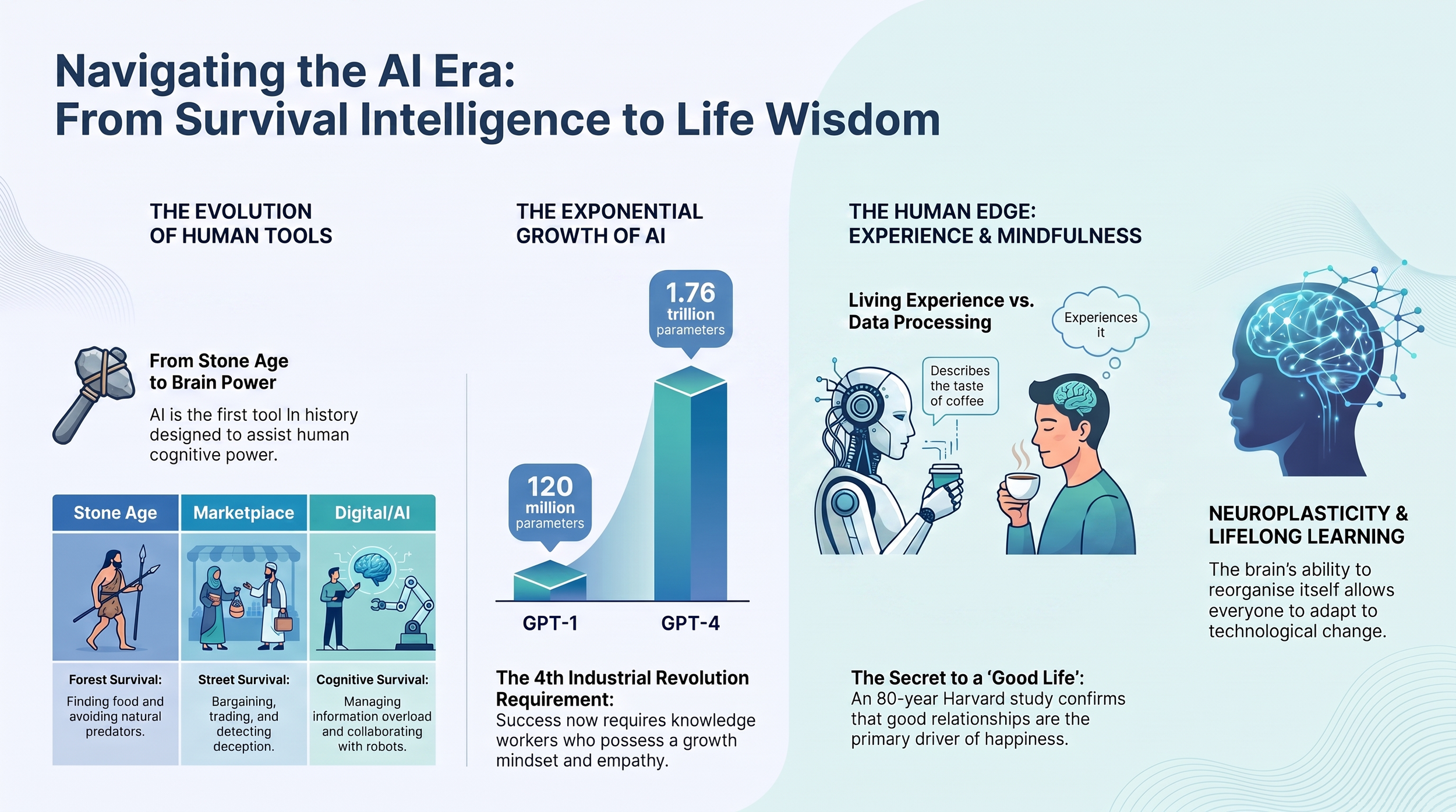
However, the current AI era represents a tectonic shift. Previous tools assisted our hands or our feet; AI is the first tool in history designed to assist our "brain power." It is not merely a calculator or a communication device like the smartphones of the third Industrial Revolution. Modern AI is characterized by its ability to make autonomous decisions and improvise based on goals. For instance, an AI agent tasked with booking a flight to Beijing doesn’t just execute a command; it analyzes your bank balance, cross-references your airline preferences, and navigates complex variables to decide which ticket serves you best.
This brings us to a precarious crossroads. By outsourcing our agency to the "silicon subconscious," we gain efficiency but risk losing the critical decision-making faculties that define our species.
3. The "Lazy Brain" Risk: What EEG Scans Reveal
The erosion of critical thinking in the face of automation is no longer a matter of philosophical debate—it is now visible in our neural architecture. A landmark 2025 study by Prof. Nataliya Kosmyna of the MIT Media Lab quantified this cognitive "hollow-out." The researchers tasked 54 participants with writing SAT essays under three conditions: using ChatGPT, using Google Search, or relying solely on their own brain power.
The results, captured via EEG, were startling. The ChatGPT group displayed the lowest levels of brain engagement. When the tool took over the heavy lifting of composition, the human mind essentially went "offline," producing essays that were functionally similar and lacked individual flair.
Conversely, the "brain-only" group showed the highest neural connectivity. Specifically, their brainwaves spiked in the alpha, theta, and delta bands. To a neuroscientist, these aren't just frequencies; they are the colors of deep work. Alpha waves indicate a state of relaxed readiness; theta waves are the engine of creative ideation and memory; and delta waves, often associated with sleep, are here essential for deep semantic processing—the ability to find meaning within complex information.
"ChatGPT may be eroding critical thinking skills... users had the lowest brain engagement, submitted similar essays and got lazier." — MIT Media Lab Study Summary, 2025
The long-term implications were even more telling: when asked to rewrite the essays months later without assistance, the "brain-only" group outperformed their AI-reliant peers, proving that cognitive struggle is the prerequisite for lasting knowledge.
4. The Happiness-Success Reversal
As we enter the Fourth Industrial Revolution—defined by "Cyber-Physical Systems"—the nature of work is shifting. Rote tasks are being automated, leaving a premium on what Prof. Ewe identifies as "growth mindset and empathy." This requires a shift in how we view the relationship between our internal state and our external output.
Traditional wisdom suggests that success leads to happiness. However, a massive review of 225 papers by Prof. Sonya Lyubomirsky and her colleagues proves the inverse: happiness leads to success. "Frequent Positive Affect" is not a luxury for the modern knowledge worker; it is a vital cognitive resource. Mindfulness creates the emotional stability required for empathy and the mental flexibility required for a growth mindset, making it the ultimate competitive advantage in an automated economy.
5. The Secret to the "Good Life" is 80 Years Old
While AI models are updated weekly, the blueprint for human fulfillment has been stable for nearly a century. The Harvard Study of Adult Development—the longest study of its kind, beginning in 1938—has followed the lives of Harvard graduates and disadvantaged Boston youths for over 80 years.
The central finding is elegantly simple: "Good relationships in life" (family, friendship, and community) are the primary drivers of health and happiness. The AI era, however, presents a direct threat to this foundation. We are increasingly plagued by digital addiction, "fragmented multimedia content," and a withdrawal from physical social interactions. When we allow algorithms to curate our social lives, we trade deep, nourishing human connections for the shallow dopamine hits of a digital feed.
6. The 47% Problem: The Cost of a Wandering Mind
The digital age has exacerbated a pre-existing human flaw: the wandering mind. Harvard psychologists Matthew A. Killingsworth and Daniel T. Gilbert found that we spend 46.9% of our waking hours thinking about something other than what we are actually doing. Their conclusion was blunt: "A wandering mind is not a happy mind."
There is a direct, troubling synthesis between the 2010 Harvard findings and the 2025 MIT study. If we are already mentally absent for nearly half our lives, and the AI tools we use in our "present" time further lower our brain engagement, we are effectively sleepwalking through the 21st century. This "distraction of mind" leads to lower learning efficiency and mental health challenges. Mindfulness is the necessary intervention—the practice of reclaiming that lost 47% and re-engaging the brain's creative bands.
7. Conclusion: Practicing "Right AI"
The evolution from stone tools to Artificial Neural Networks is a triumph of human ingenuity, but it demands a parallel evolution in human consciousness. "Right AI" is not about rejecting technology; it is about using AI as a supplement to, rather than a replacement for, our own cognitive effort. It is the path of staying "awake" at the wheel of a self-driving world.
Fortunately, our brains are not static. Through neuroplasticity, we have the lifelong ability to reorganize our neural connections. We can choose to be "lazy" and allow our critical thinking to atrophy, or we can use these tools to free up the mental space required for higher-order wisdom and deeper human connection.
As Prof. Ewe Hong Tat reminds us, we stand at a critical juncture of time where mindfulness is no longer just a spiritual practice, but a survival intelligence. By staying present, we ensure that we remain the architects of our future, rather than the passengers of our algorithms.