
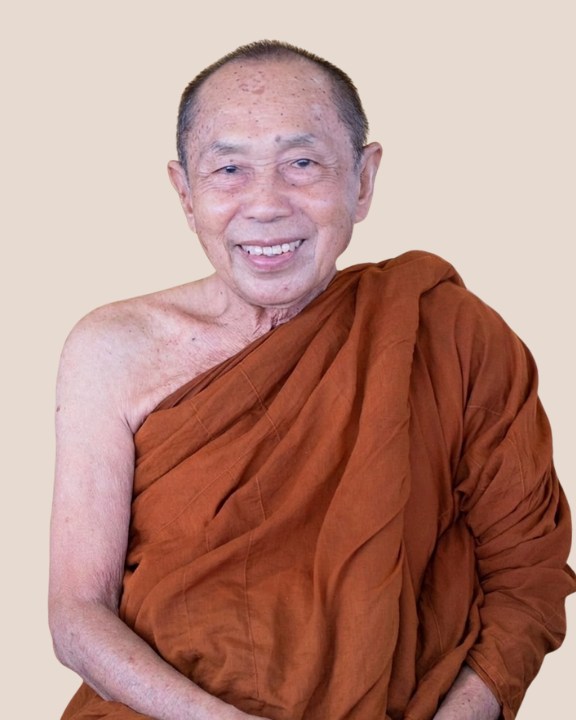
Most Venerable Luang Ta Siri Indasiri is a deeply respected meditation master and Dhamma teacher from the Thai Forest Tradition. Residing at Wat Tham Pha Daeng Pha Nimit in Khon Kaen Province, Thailand, Luang Ta Siri is celebrated for his strict ascetic discipline, unwavering dedication to mindfulness, and his selfless transition from a secular career into the holy life.
Early Life and Spiritual Heritage
Born on May 13, 1944, Luang Ta Siri was connected to Buddhism and meditation from a young age. He was a close relative and devoted follower of the revered forest monk Luang Pu Kamdee Paphaso, absorbing the pristine spirit of the Kammaṭṭhāna lineage early in life.
Before entering the monastic order, Luang Ta Siri lived a full lay life, serving his community as a dedicated school teacher and principal while raising a family.
Monastic Ordination and Practice
After ensuring his wife and children were fully provided for and formally resigning from his secular career, Luang Ta Siri dedicated his remaining years entirely to the monastic path. He received full higher ordination (Upasampada) at the age of 49 on August 1, 1993, at Wat Tham Phapu, taking the Dhamma name Indasiri.
Throughout his decades in the robes, Luang Ta Siri has maintained a reputation for strict ascetic discipline and intense, uninterrupted meditation. His teaching style emphasizes practical mindfulness, mental purity, and the transformative power of direct practice.
On 30 Aug 2026, Luang Ta Siri Indasiri teaches that the pinnacle of spiritual practice lies in the cultivation of mindfulness through breathing, explaining that the Buddha achieved enlightenment by observing this simple, natural process. He structures the path around the Seven Factors of Enlightenment, demonstrating how continuous awareness of the breath naturally transitions from initial effort to a state of joy, tranquility, and profound equanimity. By refining this practice, a seeker can develop the Threefold Knowledge, which includes recalling past lives and understanding the cessation of suffering, ultimately leading to liberation from the five aggregates. The speaker emphasizes that adherence to the five precepts provides the essential moral foundation to avoid lower realms, while the active application of these teachings is the only way to transform intellectual hearing into the fruit of Nibbana.
On 31 Aug 2026, Luang Ta Siri Indasiri explains that Dhamma is nature, specifically manifesting as the body, speech, and mind that sit here in the present moment. Most people suffer because they are lost in the illusion of self, mistakenly believing that the five aggregates—the physical and mental components of existence—belong to a permanent "I" or "mine". By deconstructing the person into the six natural elements like earth, water, and consciousness, one realises there is no owner or individual soul, only a temporary gathering of universal properties.
To attain the first stage of enlightenment, one must sever the three fetters, primarily the wrong view of self (Sakkaya-ditthi), which dissolves the ego-attachment to the physical form. This shift from wrong view to right view allows a practitioner to live without being consumed by greed or anger, as there is no longer an "I" to receive or react to emotions. Ultimately, by returning the aggregates to nature and ceasing to claim ownership over sensory experiences, the mind finds liberation in Nirvana, a state of priceless peace that cannot be bought or sold.
On 31 Aug 2026, Luang Ta Siri focuses on the attainment of Enlightenment through the systematic understanding of the Five Aggregates and the Four Noble Truths. The teacher explains that the Buddha reached the state of an Arahant by perfecting Morality, Concentration, and Wisdom, specifically by training the mind to see that the body and mind are merely a collection of natural elements rather than a permanent self. Central to the discourse is the practice of giving up attachment to the aggregates, which is described as the ultimate form of generosity required to reach Nibbana. By observing the breath and investigating the physical and mental processes, a practitioner can transcend the illusions of the ego and the cycle of rebirth. The dialogue concludes by encouraging students to simplify their practice by focusing on virtuous conduct of body, speech, and mind, viewing all phenomena as empty of a "person" or "soul".
On 1 Sept 2026, Luang Ta Siri Indasiri outlines the virtues of the Sangha, or the community of disciples, as a vital framework for reaching Nirvana. He explains that a true disciple is not defined by title but by the purification of body, speech, and mind, moving beyond mere ritual to align one's actions with the Dhamma and Vinaya. A central theme of the discourse is the deconstruction of the five aggregates, where the teacher illustrates that suffering arises when the mind mistakenly clings to these natural processes as a permanent self. By understanding that the "self" is merely a conventional designation for a collection of natural elements—earth, water, fire, and air—practitioners can dissolve attachment and enter the supramundane stream. Ultimately, the talk emphasizes that enlightenment is accessible to all who apply these teachings to their own lives, transforming the mind into a field of merit through the practice of the Eightfold Path.
On 1 Sept 2026, Luang Ta Siri Indasiri simplifies the path to enlightenment by reducing the vast Buddhist canon to the immediate cultivation of body, speech, and mind. He explains that the core of the Buddha’s teaching is found within the five aggregates, which are not abstract concepts but the physical and mental reality of our own existence. By maintaining ethical conduct and observing the rise and fall of the breath, practitioners can witness the three marks of existence—impermanence, suffering, and non-self—thereby transforming intellectual knowledge into direct insight. The discourse systematically outlines the three stages of "Sotapanna" or Stream-entry, guiding the listener from basic moral discipline to the advanced dissolution of the fetters of self-identity, doubt, and attachment to rites. Ultimately, the teacher emphasizes that realizing the emptiness of the self within the natural elements leads to the cessation of greed, hatred, and delusion, paving a clear and accessible way to Nibbana.