
Introduction: Setting the Intention for the Journey
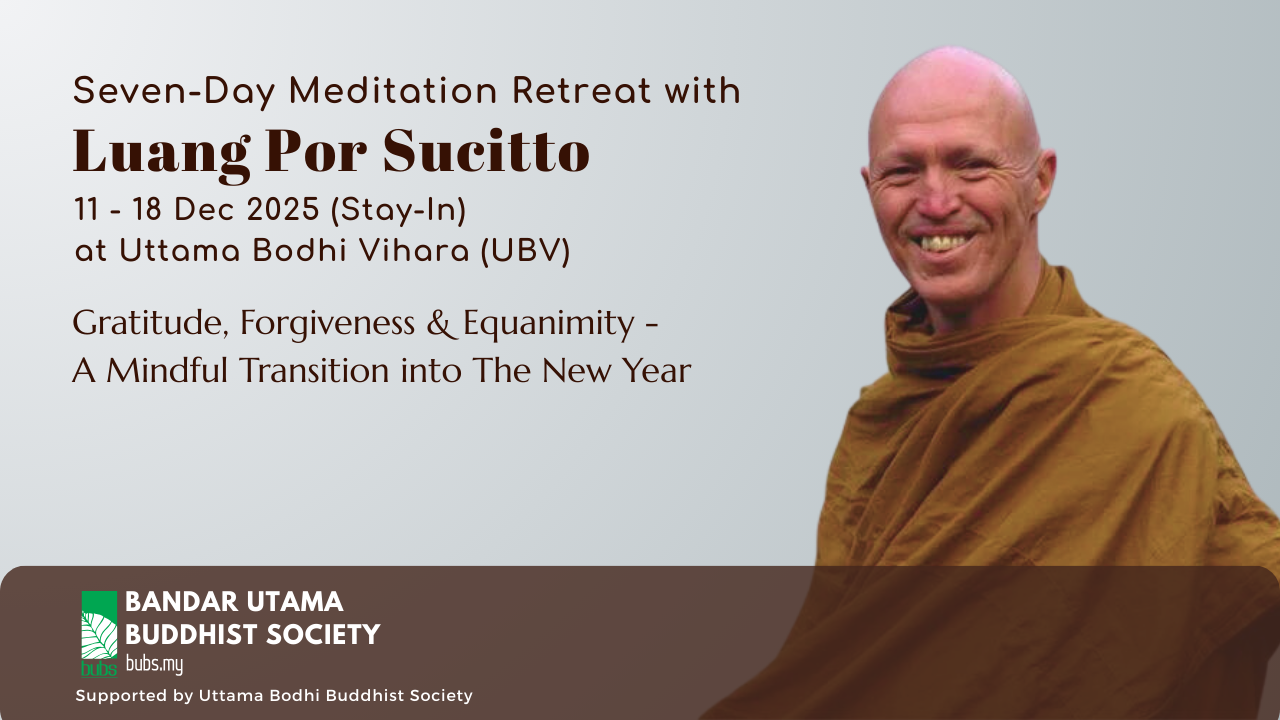
This document serves as a thematic guide to the seven-day meditation retreat led by Luang Por Sucitto and hosted by the Bandar Utama Buddhist Society. It is designed to accompany the audio recordings of the retreat, offering a map of the core teachings and the progressive journey undertaken by the participants.
The retreat was conceived as an opportunity for mindful reflection and joyful renewal as the year draws to a close. Its central purpose is to guide practitioners in cultivating the heart's essential qualities of gratitude, forgiveness, and equanimity. Over the course of the week, Luang Por Sucitto skillfully unfolds a path that moves from establishing a firm inner foundation to a profound investigation into the nature of suffering, and ultimately, to the peace that comes from relinquishment. This summary navigates through these core themes, charting the progressive unfolding of the teachings and providing a clear framework for the journey ahead.
1. Laying the Foundation: The Heart as a True Refuge
The foundational teachings of the retreat are strategically designed to establish a stable inner container for the deeper work to come. The initial days are dedicated to shifting our orientation from the external, often chaotic world to the internal landscape of the heart, or citta (heart/mind). This is not a passive withdrawal but an active cultivation of an inner sanctuary.
Luang Por Sucitto’s core instruction on the first day is to make the heart a true refuge. This process involves a conscious turning inward to relinquish unwholesome tendencies and to bring forth the virtues that lead to long-lasting welfare and benefit. It is a journey of maturation, moving from the "very small place" of "me" to a larger, more compassionate heart that allows us to, as the Buddha said, "live balanced in an unbalanced world, to live wise in a crazy world, to live steady in a very shifting changing world."
This inner cultivation is immediately put into practice through the mundane details of retreat life. Activities like sharing a room are framed not as inconveniences but as a direct practice of community, or saṅgha, and generosity. Luang Por Sucitto offers a simple yet profound principle for this: "you make yourself comfortable by thinking of other people." This outward-looking generosity, paradoxically, is what allows the heart to grow big and become a more comfortable place to live.
The initial guided meditations support this grounding. Instructions focus on establishing a balanced and composed posture, using the out-breath as a tool to "relax, release, let go." We are encouraged to shift our entire mode of operating—from a mind of constant "doing" to one of patient "receiving." By receiving the gentle comfort of the breath and the stability of the body, the heart is fed and strengthened, creating the necessary foundation to proceed. From this stable inner ground, our perspective begins to widen.
2. Widening the View: The Blessing of a Human Life
After establishing an inward focus, the retreat strategically shifts to a broader, more appreciative awareness. This cultivation of gratitude is a crucial step for lifting the heart, infusing it with gladness (pāmojja), and preparing it for deeper insights. The path, Luang Por Sucitto explains, is an "unraveling of the complexities" to find something "simple, direct that we overlooked." Gratitude is the first step in this unraveling, shifting the mind from complex seeking to simple appreciation of what is already present.
The practice is centered on a guided reflection, built around the repeated refrain: "Many beings don't get this. I recognize and reflect upon this blessing." This contemplation is not an abstract exercise but a direct inquiry into the fortunate conditions that make the path of awakening possible. We are guided to reflect on a series of profound blessings:
Attaining a human birth, the "supreme vehicle for awakening."
Having been given shelter, security, and food.
Living in a time and place where the Buddha's teachings are available.
Possessing a body and mind capable of practicing these teachings.
Having access to experienced teachers who freely offer guidance.
Being in a supportive retreat environment where food, shelter, and teachings are offered for one's welfare.
This practice grounds us in a sense of personal responsibility and appreciation for our innate capacity for awakening. The Buddha "took responsibility away from some deity" and placed it firmly in our own hands. In doing so, he revealed that awakening is not a distant goal to be found, but a present reality to be uncovered. Luang Por Sucitto offers a powerful analogy for our search: a person frantically looking all over a room for their feet, which have been with them the whole time. This reflection stops the frantic searching and brings us back to the simple, profound reality of what we already have. This uplifted and appreciative heart is then ready for a more direct examination of the mind's inner workings.
3. Exploring the Inner Landscape: Understanding the "Me Bag"
This section of the retreat represents a core psychological investigation, guiding us beyond simple calming practices to a direct examination of how suffering, or dukkha, is constructed. Luang Por Sucitto frames the citta (heart) as the locus of feeling and the epicenter of suffering. He draws a vital distinction between physical pain and the more intrusive psychological pain that arises from perceptions and emotions—such as worry, anxiety, or the feeling of being rejected.
He then details the process of "I-forming," the mechanism by which suffering becomes personalized and entrenched. He offers a precise psychological model:
Me: The recipient of experience. A perception arises ("you made me feel like an idiot"), and it lands in what he calls the "me bag."
I: The agent, the response that is generated from the "me bag" ("I get angry").
Myself: The solid, seemingly permanent sense of being that arises when "me" and "I" are perceived operating together.
Luang Por Sucitto offers a crucial insight: the pain itself is impersonal. Disagreeable feelings, he explains, are a universal part of sentient existence; "everybody gets this." The key distinction lies in our relationship to that pain. To be in pain is to identify with it, to become the "abused person" or the "betrayed person," thereby solidifying the "myself" and perpetuating the cycle. To be with pain, however, is to observe it from a place of equanimity, to see it as an impersonal phenomenon arising and passing away. This shift in perspective—from being in the experience to being with it—is the essential key to breaking the reactive cycle of suffering and is the foundation for the active path of practice.
4. The Path of Practice: Meeting Difficulty with Wisdom
The retreat places a strong emphasis on practice as an active, engaged, and skillful process. Wisdom is not presented as theoretical knowledge but as the applied skill of meeting challenges with balance and clarity. It is the art of navigating the inevitable difficulties of life without being capsized by them.
Luang Por Sucitto teaches that true practice is "meeting difficult conditions." The path is not about controlling external circumstances to avoid discomfort. Rather, the real work involves exposing and rooting out latent potentials for ill will, doubt, and restlessness that are otherwise suppressed when our environment is arranged for comfort. Monasteries, he notes, are often intentionally not arranged for personal comfort, precisely to provide the friction needed for these potentials to surface and be worked with.
The primary tool for this work is the cultivation of a wider, more spacious attention. Luang Por Sucitto gives the practical example of managing physical discomfort: instead of fixating on the pain, one expands awareness to include the whole body. The painful area, though still present, is no longer dominant; it becomes just "10%" of the total field of experience, and one is no longer mastered by it.
This leads to the cultivation of viveka (stepping back) and virāga (dispassion). This is not suppression but the creation of a "psychological space" that allows emotions and thoughts to be seen clearly as objects in awareness. By holding them in this spacious perspective, the compulsive habit of identification is broken. We learn that we can feel an emotion without becoming that emotion. This is the heart of the practice: using the raw material of difficult experience to cultivate an unshakable inner poise, transforming the very agent of practice in the process.
5. The Fruit of Relinquishment: The Calming of All Formations
The ultimate aim and fruition of the retreat's journey is not an achievement but a profound letting go. The culmination of the path is found not in gaining something new, but in the peace that arises from relinquishing the burdens the heart has been carrying. Luang Por Sucitto points to a key phrase from the Buddha's teachings that encapsulates this final goal:
"This is peaceful, this is sublime: the calming of all saṅkhāras... the relinquishment of all substrate... the destruction of craving... cessation."
What is being relinquished is the entire apparatus of self-creation. This includes the constant mental chatter, the habit of judgment, the endless stories of the past, and the foundational "I am" identity that is built upon suffering. To illustrate the futility of blame, Luang Por Sucitto shares a parable: a baby is killed by a falling sickle. The king traces the cause from the woman who dropped it, to the rabbits she was fleeing, to the snake that scared them, to the monkey that disturbed it, to the bird that startled it with a song of joy at the sight of the moon. The king summons the moon, who says, "God created me." But when they search for God, he cannot be found. The causal chain is endless; the only sane response is to "put down the weapon" of judgment.
The journey is fundamentally transformative. The person who begins the practice is not the same one who reaps its benefits. As Luang Por Sucitto insightfully states, "The one who does the aiming is not the one who receives the results. The one who does the aiming gets changed by the process." The very act of cultivating steadiness, wisdom, and compassion dissolves the constricted, suffering self and allows a more spacious, peaceful, and liberated heart to emerge.
May this guide serve as a faithful companion on your journey. Use these teachings not as maps to be studied, but as footprints to be followed, leading you back to the peace and freedom of your own heart.